Over recent years, the conversation around skin longevity has focused on what we apply to our skin. From sophisticated skincare routines and active ingredients to daily SPF and regenerative treatments, consumers have become increasingly educated about protecting and preserving their skin.

While our routines have become more advanced, our understanding of our own skin has often remained limited. Now though, the next evolution of skin longevity is emerging. One that is not simply about more advanced products, but about establishing a baseline understanding of our skin health over time, identifying changes before they become concerns.

We know more about skincare than ever before

Today’s consumers are investing more time and money than ever in maintaining healthy skin. Daily sun protection has become commonplace. Ingredients such as retinoids, peptides and antioxidants have entered everyday vocabulary. Professional treatments continue to grow in popularity. This development in skincare reflects a broader shift towards longevity. One that values prevention over correction and long-term wellbeing over short-term results. Despite this growing general awareness, many people still have little understanding of their individual skin health. 

Prevention is changing the conversation

Just as preventative healthcare encourages us to establish health baselines before symptoms arise, skin health is beginning to follow the same path. Rather than relying solely on visual checks, advanced imaging technologies now allow clinicians to build a comprehensive picture of the skin and monitor it over time. This changes the conversation from treatment to understanding. Instead of asking “How does my skin look today?”, the more important question becomes: “How is my skin changing?”. A London-based practice at the forefront of this movement towards understanding skin health is Welbeck.

Early intervention with Welbeck

As preventative healthcare evolves, so do the tools available to support it. Taking the example of Welbeck’s Health Assessment & Longevity Clinic, preventative skin health forms part of a wider philosophy centred on early detection and proactive care. Forming part of its Modern Health Assessment, Welbeck’s 360° mole mapping service uses the VECTRA WB360 – one of the UK’s most advanced skin imaging systems – to create a complete 3D image of an individual’s skin surface in a single session. This comprehensive baseline enables clinicians to monitor moles and lesions over time, making it easier to identify subtle changes that may warrant further investigation. Rather than replacing routine skin awareness, technologies such as those used by Welbeck enhance it.

The future of skin longevity

Skin longevity is no longer simply about how we look on the surface and the extent of our skincare routine. Increasingly, it is about investing in understanding our health before concerns arise. This forms part of a broader preventative health mindset – one that values knowledge, early detection and informed decision-making as much as the products we use each day. As the longevity movement continues to reshape healthcare, understanding our baseline skin health through assessments like those carried out by Welbeck may prove to be one of the most valuable investments we can make.
Something is shifting in the world of luxury travel. In an era defined by overconsumption and overtourism, the most discerning travellers are doing something different: slowing down, seeking out the route less obvious and choosing depth over breadth. The result is a travel landscape that feels, refreshingly, more human than it has in years.

Here are the key luxury travel trends shaping how the world’s most thoughtful travellers are exploring it today.

Purpose-Driven and Authentic Travel Experiences

The shift away from ticking off destinations towards genuinely experiencing them is perhaps the most significant change in luxury travel today. Today’s traveller is not simply looking for luxury in comfort – they are looking for meaning. Whether that’s a private cooking lesson with a family in rural Puglia, a walk through a city’s hidden neighbourhoods with a local historian or a stay at a boutique hotel deeply rooted in its landscape and community, these authentic, purpose-driven experiences are what truly stay with people.

The Evolution of Holistic Wellness Travel

Wellness has been a growing force in travel for some time, but its influence continues to expand. Today, it is less about a single spa treatment or an isolated retreat and more about the entire philosophy of how a journey is designed. Sleep, nutrition, movement, stillness and a deep connection with nature are increasingly shaping where people choose to go and how they spend their time. The most compelling wellness destinations are those that feel inherently restorative, where the landscape and pace of a place set the scene long before a treatment is booked.

Digital Detox: Fewer Screens, Human Connection

There is a growing desire among luxury travellers to disconnect – not simply from work, but from the constant pull of notifications and digital noise that has become the backdrop of modern daily life. The luxury travel brands responding to this most thoughtfully are those that make disconnection feel natural. They offer design that encourages conversation over scrolling, itineraries shaped by culture and connection, and hyper-personalised human service rather than screens.

Emerging Destinations: The “If You Know, You Know” Effect

Overtourism has quietly but significantly changed how considered travellers approach destination choice. Places of extraordinary beauty like the Amalfi Coast, Santorini and Dubrovnik have, in peak season, become victims of their own appeal. In response, a new tier of off-the-beaten-path luxury destinations is emerging: Lake Orta, the Azores, Georgia’s ancient wine country and the quieter islands of the Greek archipelago. These are places where the experience is exceptional, the individual character remains intact and the crowds have yet to arrive.

The Future of Luxury Travel

These trends all share a common thread: a desire for travel that gives something back. The luxury travellers leading this shift are not turning their backs on quality or beauty – they are simply asking more of it. They want more meaning, more authenticity and more genuine connection with the places and people they encounter along the way. The most compelling luxury travel brands are those that have understood this earliest: in a world of endless options, the most powerful thing a travel experience can offer is the feeling that it was made, in some essential way, specifically for the guest.

There is a particular kind of atmosphere that settles over a classic car event done well. The rumble of a rare engine. The animated conversation between people who share a genuine passion. The sense that, for a few hours at least, the pace of the world has slowed to something more considered. These are not simply automotive showcases – they are gatherings built around connection, appreciation and the enduring human love of quality and craft. 

London’s calendar of classic car and supercar events has quietly become one of the most compelling series of occasions in the city’s luxury calendar… and the most thoughtful brands have been paying close attention.

The Defining Events of the London Luxury Season

Three events in particular have established themselves as highlights of the London season. Salon Privé at the Royal Hospital Chelsea in April opens proceedings with warmth and elegance – part concours, part garden party, entirely considered. The London Concours at the Honourable Artillery Company follows in June, bringing together some of the world’s most remarkable motorcars against the backdrop of one of the city’s most characterful and historic venues. September then brings the Concours of Elegance to Hampton Court Palace – a setting so spectacular that the cars themselves arrive almost as conversation partners to the landscape rather than centrepieces within it.

What connects all three is not simply the quality of the vehicles. It is the quality of the experience – the care taken in curation, the sense of occasion and the genuine enthusiasm of those in attendance. These events draw together collectors, creatives, founders, enthusiasts and tastemakers who share a common appreciation for craft, heritage and the stories that objects carry with them. These are not transactional spaces. They are cultural ones.

Why Luxury Brands Belong at Classic Car Events

The relationship between luxury brands and the world of vintage and supercards is one of natural kinship. Heritage, craft, attention to detail and something above and beyond the ordinary – these are values that resonate across fine watchmaking, champagne, travel, property and beyond. It is little wonder that brands from these worlds have long gravitated towards classic car events as a place to meet their communities in a meaningful setting.

But the partnerships that truly land are those that contribute something genuine to the experience rather than simply occupying space within it. A beautifully hosted lunch. A thoughtful conversation with a maker or collector. A moment that feels personal rather than produced. These are the touchpoints people carry with them, the ones that build real affinity between a brand and its community. This is experiential marketing at its most thoughtful: not interrupting the moment, but enriching it.

The Power of Gathering: Moving Beyond Digital 

What makes London’s classic car events so enduring is something no strategy document can fully capture: the simple, powerful act of people coming together around something they love. Attendees return year after year not only for the cars, but for the conversations, the familiar faces, the new introductions and the shared pleasure of being in a beautiful place with curious, passionate people around them.

For brands looking to connect with their communities in a way that feels genuine rather than transactional, this matters enormously. As digital channels grow ever more crowded, the value of a real gathering – one with atmosphere, purpose and the space for real conversation – has never been stronger. These events offer something no platform can replicate: the chance to be truly present with the people who matter to your brand.

At Luxury Marketing House, we believe the most effective marketing happens when a brand shows up authentically; in the right place, at the right moment, with something real to offer. London’s classic car season is one of the most richly human the city’s luxury calendar has to offer. The brands that embrace it thoughtfully will find it one of the most rewarding too.

There is a rhythm to the luxury calendar that those who move within it come to know well. A quiet anticipation that builds as one season gives way to the next. The knowledge that certain weeks, in certain cities, will bring together interesting, creative and ambitious people from around the world – not by chance, but by shared instinct. These are the moments the luxury world organises itself around. And at Luxury Marketing House, these are the moments we follow most closely.

Because beyond the spectacle, the sport and the art, what these events share is something more enduring: the power of community. Of people gathering with purpose, in places that matter, around experiences that cannot be replicated online. In an age defined by digital saturation, that power has never felt more relevant – or more valuable. Here is the global luxury event calendar we are watching in 2026 and why it matters.

Q1: High-Altitude Luxury and Art World Convergence

January: St. Moritz Polo World Cup on Snow The year begins in the Alps, where the St. Moritz Polo World Cup on Snow transforms a frozen lake into one of the most visually extraordinary sporting arenas in the world. It’s a fitting opening to the luxury calendar – a reminder that the most memorable experiences are those that marry the unexpected with the exceptional. For brands present in St. Moritz in January, the opportunity is not simply visibility. It’s the chance to be part of a moment that feels completely unique.

March & April: Art Basel Hong Kong As spring arrives, the global art world convenes in Hong Kong for Art Basel – one of the most significant cultural gatherings of the year for collectors, gallerists, curators and creative minds from across Asia and beyond. For luxury brands, Art Basel Hong Kong represents an opportunity to engage with a culturally sophisticated, internationally minded audience in a setting where creativity and commerce naturally coexist.

Q2: Heritage Sport and the Riviera Season

April: The Masters, Augusta, Georgia Few sporting events carry the weight of tradition quite like The Masters. Held each April at Augusta National, it’s a week that brings together a remarkably loyal and passionate community that values heritage, excellence and the distinct thrill of sport played at the highest level. The Masters is not loud. It does not need to be. And the brands that understand this – those that show up with the same restraint and intention the tournament itself embodies – are the ones that resonate most deeply.

May: Miami Grand Prix & Cannes Film Festival May brings two of the calendar’s most high-energy moments in quick succession. The Miami Grand Prix has rapidly established itself as one of Formula 1’s most vibrant destinations – a fusion of sport, music, fashion and culture that draws an extraordinarily diverse and engaged global audience. Meanwhile, on the French Riviera, the Cannes Film Festival transforms a coastal city into the centre of the world’s creative imagination for two extraordinary weeks. Film, fashion, art and commerce unite in a way that is uniquely Cannes, and uniquely compelling for any brand with a story worth telling.

June: Monaco Grand Prix & Royal Ascot Moving into June, we see two examples of the luxury world at its most iconic. The Monaco Grand Prix is the ultimate mix of speed, glamour and destination – a race that has been woven into the fabric of the luxury calendar for decades and whose appeal shows no sign of softening. Royal Ascot, later in the month, is quintessentially British – a week of racing, ritual and elegance on its pristine Berkshire turf that draws racegoers from around the world. Both events are the perfect occasions for brands that understand the art of showing up beautifully.

Q3: Summer Traditions and the Superyacht Circuit

July: Wimbledon There are few more universally beloved events in the global calendar than Wimbledon. For two weeks each July, the All England Tennis Club becomes a place where sport, tradition and community come together in the most gracious of settings. Strawberries, grass courts, the crowd’s inimitable hush before a serve – these are the details that make Wimbledon iconic. For brands, it is a reminder that the most powerful associations are often the simplest ones: a presence that feels earned rather than imposed.

September: Monaco Yacht Show As summer draws to a close, the world’s most exceptional yachts gather in Port Hercules for the Monaco Yacht Show – the definitive event for the superyacht industry and the community that surrounds it. Shipbuilders, designers, brokers, owners and connected brands come together in a setting that is, in itself, a testament to the art of living well. For those operating in the yachting, aviation, property and luxury lifestyle spaces, Monaco Yacht Show is the natural place to be come the end of September year after year.

Q4: Cultural Curation and the Global Grand Finale

October: Frieze London & Frieze Masters October brings the art world back to London, as Frieze transforms Regent’s Park into one of the most anticipated cultural destinations of the year. Frieze London and Frieze Masters together offer something remarkable – a conversation between the contemporary and the historical, between emerging voices and established masters. The audience it draws is curious, creative and deeply engaged. For brands that value cultural relevance and genuine connection with the creative community, Frieze is an opportunity not to be missed.

November: Melbourne Cup November draws the calendar south to Australia, where the Melbourne Cup brings the country to a collective standstill for three minutes and twenty seconds. Known the world over as the race that stops a nation, it is so much more than a sporting event – it is a cultural institution and a gathering point for an extraordinarily passionate community. Flemington Racecourse has an energy that is entirely its own: joyful, colourful and deeply communal. For brands looking to connect with Australian audiences – and the international crowd that travels for it – few occasions on the global calendar offer quite the same spirit.

December: Art Basel Miami Beach, Abu Dhabi Grand Prix & St. Barths New Year’s Eve The year closes with a trio of moments that together capture the full breadth of the luxury world’s global character. Art Basel Miami Beach brings the energy of South Florida to one of the art calendar’s most celebrated events – sun-soaked, vibrant and full of creative energy. The Abu Dhabi Grand Prix offers a spectacular season finale for Formula 1 in a city that has firmly established itself as one of the world’s great luxury destinations. And as the countdown to a new year begins, St. Barths welcomes those seeking the most considered of send-offs to the year just passed – an island that understands how to mark an occasion exceptionally.

Strategic Insight: What the 2026 Calendar Tells Us

Taken together, this is more than a list of events. It is a map of the moments around which the global luxury community organises itself – the gatherings that bring people together with shared purpose, in places that inspire, around experiences that endure in the memory long after they are over. At Luxury Marketing House, we follow this calendar not simply as observers, but as believers in what it represents. Because the most meaningful marketing – the kind that builds genuine affinity and lasting relationships – happens in the spaces between the screens. In the conversations, the introductions, the shared moments that no algorithm could have arranged.

In conversation with Sonia Spring, Managing Director of Clinique La Prairie Holistic Health – a visionary in the field of modern wellness and the force behind one of the most innovative supplement brands in the industry – we explore the evolving definition of longevity, the role of leadership in shaping modern wellness, and how science, lifestyle and mindset are redefining how we live.

Our theme today is longevity, leadership and the future of wellbeing. To begin, could you share a little about your journey into wellness?

I actually started in a very different world – watchmaking. Being Swiss, it was a natural path, and I spent over 15 years within a luxury group, moving from product into retail across Europe and Southeast Asia. Retail, in particular, shaped my understanding of client experience – the importance of service, connection and detail. Then, at a certain point in my career, I met Simone Gibertoni, CEO of Clinique La Prairie. The vision was incredibly inspiring. Wellness and longevity were already emerging as important themes, and I felt there was something very meaningful in this space. I decided to take everything I had learned and move into wellness and I’ve never looked back. It’s a constant learning journey, but also incredibly fulfilling to be able to contribute to people’s health and quality of life.

Clinique La Prairie has nearly a century of heritage. What does it mean to lead its holistic health offering today?

Being here in Montreux, where it all began almost 100 years ago, you feel that heritage every day. There is a real sense of responsibility as well as pride in carrying that forward. Longevity may be a widely used term today, but for us it has been central for decades. What makes it exciting is not just the past, but the future. We are constantly innovating – not only in products, but in services – always bringing something new to this field. It’s about connecting that heritage with forward-thinking innovation in a way that remains meaningful.

How is the role of supplements and wellness evolving in people’s daily lives?

There has been a real shift. In the past, supplements were often taken occasionally to address a specific need at a moment in time. Today, it’s different. People want to feel better every day. They want more energy, more performance, more balance. It’s becoming part of a lifestyle. What we aim to do is inspire that shift, encouraging people to adopt habits that support their long-term wellbeing and future health. It’s no longer about reacting, but about integrating these practices consistently.

Science plays a key role in what you do. Could you explain the significance of epigenetics?

Most people are familiar with genetics, something fixed that we inherit. Epigenetics is different. It’s about how those genes are expressed. Through lifestyle, nutrition and daily habits, we can influence that expression, effectively switching certain functions on or off. This means we can positively impact how our body behaves, including slowing aspects of ageing. It’s a fascinating space, and one we are exploring deeply. It represents a new dimension in how we understand longevity, as something that can be actively shaped.

You lead with clarity and compassion – something we’ve always admired. How has your leadership style evolved?

It has definitely evolved over time. Early in my career, I was very focused and driven, but perhaps more inward – concentrating on my own performance. At one point, I was told: “You’re performing well, but you need to bring people into your world.” That stayed with me. From then on, I worked on creating more connection – engaging with people, listening and building trust. I’ve also been fortunate to have mentors who led in this way. For me, leadership today is about merging heart with head. Performance matters, but so does connection. It’s about creating an environment where people feel confident to contribute, to take ownership and to grow.

What is the most important lesson you’ve learned as a leader?

That leadership is not about having all the answers. It’s about creating a space where others feel able to bring ideas, to contribute and to take ownership. Trust is fundamental and so is humility. Sometimes, the best direction comes from the collective energy of the team.

Looking ahead, what do you see shaping the future of wellbeing?

Epigenetics will continue to be a major area of development. Beyond that, functional medicine – addressing specific needs such as energy, gut health or women’s health – will grow in importance. And mental wellbeing is becoming increasingly central. We are living in a demanding world, both professionally and personally. Supporting balance, clarity and mental health will be key.

And on a personal level, what practices help you feel your best?

Meditation has become very important for me. It allows me to disconnect and then return with more clarity. Nutrition is also key – making conscious choices that support energy and overall wellbeing. And finally, gratitude. Taking time to appreciate even small moments helps me to stay present and grounded.

Finally, how would you define longevity today?

For me, longevity is the art of thriving at every age. It’s about being aware, being mindful and taking steps that allow you to be healthy, happy and performing at every stage of life.

Listen to the full conversation below.

Luxury has always been personal. From the private atelier appointment to a handwritten note accompanying a special acquisition, the essence of luxury has never been scale; it has been significance. True luxury is about feeling recognised. Today, personalisation is entering a new era. Artificial intelligence, predictive analytics and behavioural insights are shifting how brands understand and engage with their clients. In this ever-changing landscape, hyper-personalisation in luxury is no longer a differentiator. It is, instead, an expectation. For brands, the question is no longer whether to personalise, but how to do so while preserving exclusivity, emotional depth and brand integrity.

From Personalisation to Hyper-Personalisation in Luxury

Traditional personalisation relied on segmentation, grouping customers according to demographics, geography or their purchasing behaviour. While effective in broader markets, this approach falls short within the luxury sector. This is because high-net-worth and ultra-high-net-worth clients expect to be recognised as individuals, with distinct preferences, priorities and sensibilities. Hyper-personalisation in luxury moves beyond static data sets and retrospective analysis. It draws on real-time behavioural insight, predictive analytics and AI-driven content adaptation to create experiences that feel intuitive rather than reactive. It ensures continuity across digital and physical touchpoints, shaping client journeys that feel coherent and individually curated. This evolution allows brands to anticipate needs before they are articulated. It enables them to curate rather than promote and to converse rather than broadcast. In luxury, this distinction is critical. When a client feels genuinely understood, loyalty becomes emotional rather than transactional.

Why AI Is Reshaping Luxury Engagement

Artificial intelligence is often misunderstood within the luxury industry. Some fear that automation will dilute exclusivity or erode craftsmanship. Others reduce it to an operational efficiency tool. In reality, AI is neither a replacement nor a shortcut – it is an amplifier. When implemented thoughtfully, AI in luxury marketing enables brands to identify nuanced behavioural patterns that would otherwise remain invisible. It allows for the delivery of relevant messaging at precisely the right moment, it refines communication in line with evolving preferences and it strengthens CRM strategies through predictive intelligence. It can even support client advisors with deeper contextual insight, enhancing high-touch interactions rather than replacing them. Crucially, AI does not substitute human intuition; it strengthens it. In the same way that master craftsmanship is supported by precision instruments, luxury marketing strategies can be elevated through intelligent systems – provided brand identity remains central, of course. Technology without sensitivity feels mechanical, and creativity without insight feels disconnected. The brands that will lead are those capable of balancing both.

The Risk of Getting It Wrong

In pursuit of digital sophistication, many luxury brands fall into one of two traps. The first is over-automation, where excessive reliance on templates and AI outputs gradually erodes a brand’s distinctive identity and emotional nuance. The second is the under-utilisation of data, where instinct alone is favoured, risking a brand’s irrelevance in an increasingly competitive landscape. Luxury audiences are discerning. They recognise immediately when engagement feels generic and when it feels considered. Hyper-personalisation in luxury is not about volume nor frequency; it is about precision with purpose.

Why Personalisation Is Now a Strategic Imperative

The expectations of today’s luxury client have evolved. Seamless digital-to-physical experiences are assumed. Recommendations must align with lifestyle rather than simply past purchases. Content journeys should reflect personal taste, and brand interactions should feel intuitive and elevated at every stage. For UHNW audiences in particular, time has become the ultimate currency. Brands that reduce friction while increasing relevance immediately enhance their perceived value. Personalisation, as such, is no longer simply a marketing tactic – it’s core to building a long-term relationship with a brand’s community.

LMH’s Approach: Bespoke at the Core

At Luxury Marketing House, personalisation is core to our DNA. We are a boutique, senior-led agency, always working in close collaboration with our clients. We collaborate with established luxury brands as an extension of their teams to craft bespoke marketing strategies that honour their heritage while simultaneously future-proofing growth. Rather than creating standardised frameworks, we develop strategies and ways of working that are entirely personalised to each brand we work with. We believe that luxury marketing should feel as refined as the products or services being represented. In short, every brand deserves its own blueprint.

Streamlined Solutions: Intelligent Growth for Emerging Luxury Brands

While bespoke strategies remain central to our work with established brands, we recognise that emerging and next-generation luxury brands need both agility and efficiency. This is where our Streamlined Solutions come into focus. Designed specifically for developing brands at the early stages of their journeys, our Streamlined Solutions embrace the advantages of AI, automation and intelligent frameworks without compromising human insight and creative thinking. Through AI-enhanced audience segmentation, data-driven campaign optimisation and scalable content ecosystems, we support younger brands in establishing clear positioning and coherent marketing strategies from the outset. Strategic brand frameworks are paired with efficient yet elevated marketing infrastructure, ensuring that growth is not only accelerated but sustainable. The objective is clear: to empower emerging luxury brands to grow intelligently, sustainably and with precision. Streamlined doesn’t mean standardised; it means strategically engineered for impact.

The Future of Luxury Is Personal

In an era defined by AI, the brands set to succeed are those that use data without losing their identity, brands that embrace innovation without abandoning their heritage. Hyper-personalisation in luxury represents the evolution of the sector’s oldest principle: making the client feel singular. At LMH, we don’t see AI as a disruption to luxury but as a tool that, when guided by expertise and strategic insight, can deepen relationships and unlock a new dimension of brand resonance. The future of luxury is not mass. It is considered. It is intentional. And above all, it is personal.

EXPLORE HOW LMH PARTNERS WITH LUXURY BRANDS

Discover the perfect blend of festive tradition and modern marketing in this season's most enchanting designs.

For those who celebrate Christmas, the traditional advent calendar has always been a testament to creativity.

Rooted in simple, artful designs that evoke the magic of the season, these treasures have captured the imagination of children and adults alike for generations. Far more than just a countdown, a traditional paper advent calendar offers a journey of discovery, each window revealing a small, magical moment to inspire and delight.

In recent years, brands have reinterpreted this tradition, blending its timeless artistry with a contemporary marketing opportunity. In the luxury sector especially, the advent calendar has become a pivotal seasonal opportunity. Indeed, in 2024, it is rare for an established brand to forgo this festive moment entirely.

Yet, this rise in commercialisation often risks unravelling the creativity and beauty that define the advent calendar’s entire meaning.

To celebrate the start of December, the LMH team have picked out three luxury brands that have, this year, upheld the advent calendar’s traditional spirit while embracing its commercial potential. These designs successfully honour artistry and imagination, proving that luxury and authenticity can co-exist at Christmas.

Newby London

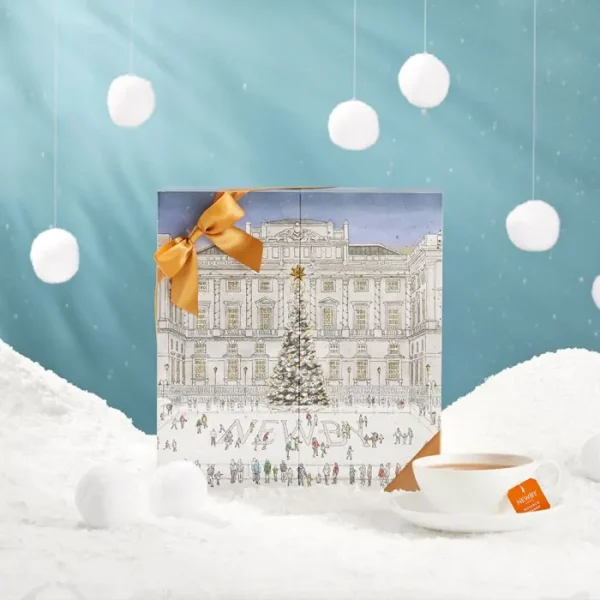
Marking its 10th anniversary, Newby London’s 2024 Advent Calendar captures the festive essence of London’s iconic Somerset House. Skaters glide under the glow of a grand Christmas tree, a scene elegantly illustrated on this calendar’s design.

Each of its 24 drawers holds four sachets of Newby’s finest teas, from classic English Breakfast to fragrant Jasmine Blossom, offering a comforting exploration of flavours for tea lovers. The calendar’s elegant illustration and the sensory journey it offers celebrate the joy of a traditional advent experience, elevated by artisanal craftsmanship.

Sisley

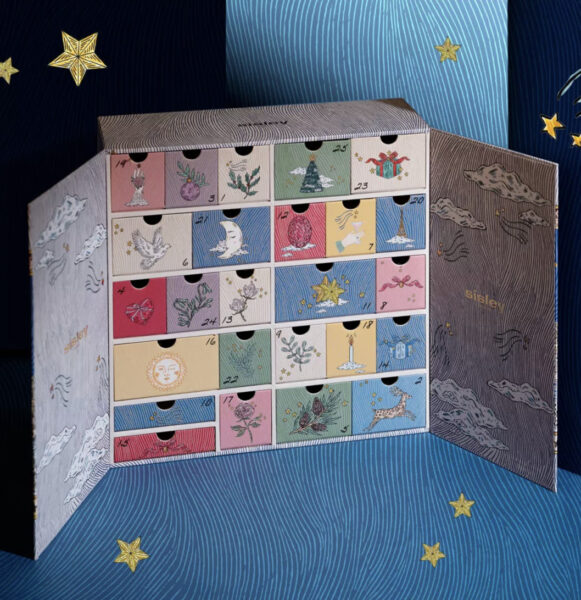
Sisley’s 2024 beauty advent calendar offers a stunning interpretation. Illustrated by British artist Fee Greening, known for her intricate, medieval-inspired pen-and-ink style, it transforms the calendar into a Parisian dreamscape.

The romantic design is combined with Sisley’s luxurious skincare and cosmetics. This indulgent calendar thus reflects a dedication to artistry and tradition, while offering beauty enthusiasts curated surprises that enhance the countdown to Christmas.

Fortnum & Mason

It comes as no surprise that Fortnum & Mason excels in this realm. Long synonymous with festive elegance, the world-famous ‘corner shop’ is best-in-class at creating advent calendars that radiate timeless charm.

The traditional paper calendar, depicting the Piccadilly storefront, stirs nostalgia with its pop-out characters and intricate illustrations.

For a more enduring option, their wooden calendars – including one featuring the same iconic storefront – are designed for reuse year after year, making each a keepsake to cherish. These beautifully crafted pieces capture the warmth and joy of Christmas at Fortnum’s, blending tradition with the excitement of discovery, while inviting a personalised collection of treasures behind each door for years to come.

These brands demonstrate that the advent calendar can remain a celebration of imagination, even in a commercial age, ensuring that the magic of the tradition continues to shine, one door at a time.


In today’s saturated market, where competition is fierce and consumer attention is fleeting, the importance of brand application cannot be overstated – particularly for smaller businesses trying to carve out a niche. When you look at any successful luxury brand, one thing becomes immediately apparent: their brand application is impeccable. It’s premium, consistent, and well executed across all touchpoints, from social media to newsletters, websites to packaging. This consistency builds credibility and defines the brand’s luxury presence.

As a brand communications specialist, I firmly believe that a brand’s application is a direct reflection of its quality. I am far more likely to engage with a company if its online presence feels polished and premium. Whether it’s their social media feed, their website’s design, or the quality of their newsletters, it all conveys a level of investment in their identity. This, in turn, signals to me that the same attention to detail will be found in their products or services. It’s a visual shorthand for quality.

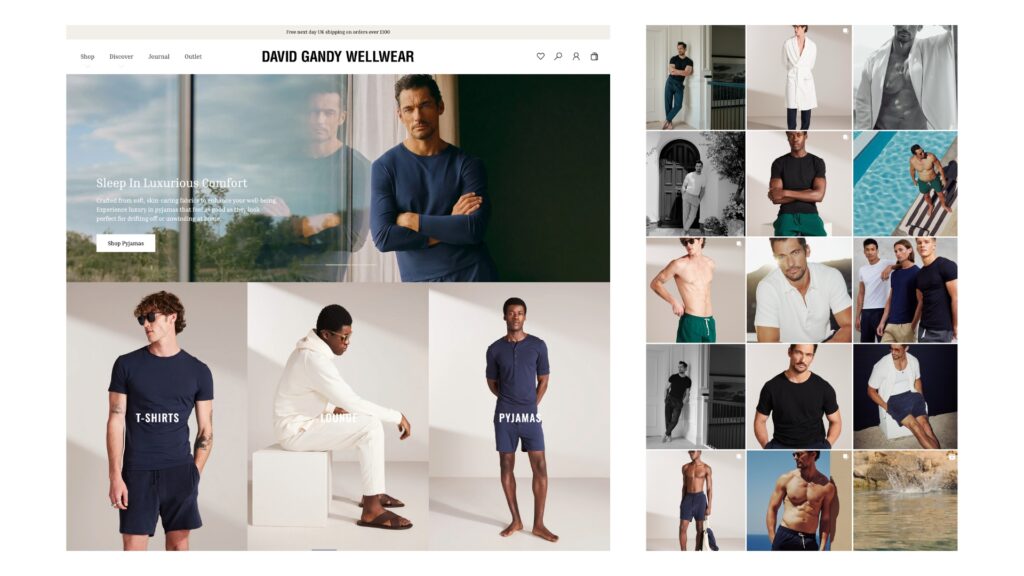
Emerging aesthetic brands have mastered this. Brands like Refy, Matteau, and David Gandy Wellwear are prime examples of companies that have risen to success, thanks in part to their cohesive brand application. They’ve developed a distinct visual and tonal identity and remained steadfast in their commitment to it.

It’s essential to remember that a brand’s identity goes far beyond just a logo. Consistent application of colours, fonts, and photography styles is equally crucial in creating a unified and recognisable brand presence. These elements work together as brand identifiers, shaping how consumers perceive quality, exclusivity, and trustworthiness.

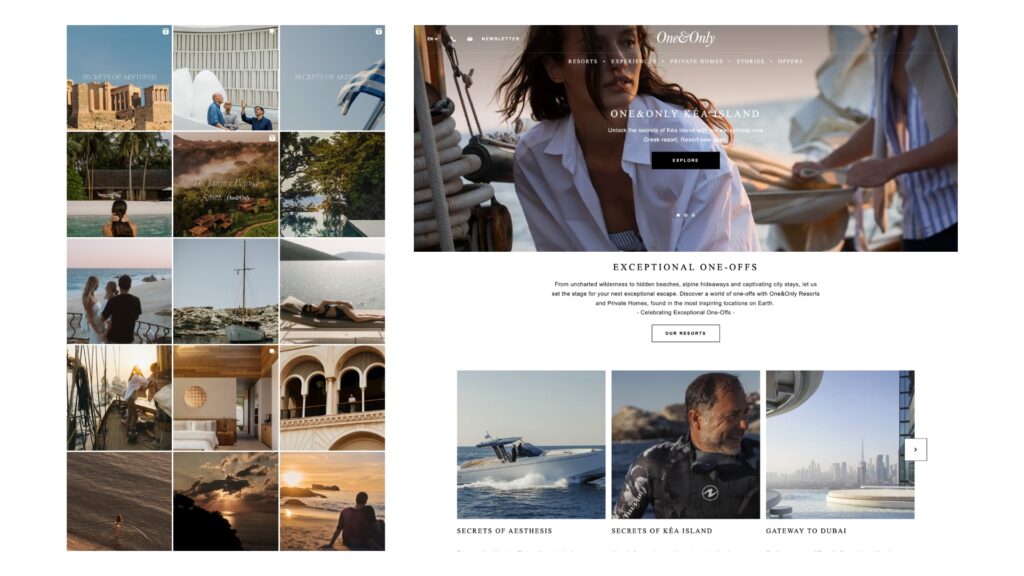
Established luxury brands like One&Only Resorts, Wheely and Bottega Veneta have demonstrated that consistency in brand application does more than just reflect attention to quality – it drives trust. Their cohesive visuals and messaging create an aspirational appeal that makes customers feel like they are buying into a lifestyle, not just a product.

One of the most common mistakes I see is brands with incredible products being undermined by poor digital presence. A website that feels outdated or a social media feed that’s visually chaotic can ruin the perception of an otherwise high-quality offering. In today’s digital-first world, the brand experience often begins long before someone touches a product – it starts the moment they land on your website or Instagram feed. If that first impression isn’t polished, potential customers may assume the product isn’t either, regardless of its true quality.

Ultimately, investing in brand application is no longer optional for businesses wanting to thrive in a competitive landscape. It’s a vital part of marketing strategy that, when done right, leaves a lasting impact. Brands that understand this will not only stand out but also build long-term loyalty and trust with their audience.

Quick Tips for Effective Brand Application

Consistency is Key
Ensure that every touchpoint – from your website to social media, email marketing, and packaging – follows a cohesive visual and tonal identity. This builds trust and recognition, making your brand more memorable and credible.

Invest in Quality Design
High-quality visuals signal a high-quality product. Whether you’re a small business or a luxury brand, working with professional designers to create a clear, compelling identity is key to establishing a premium feel.

Define Your Visual Elements
Go beyond the logo. Define your brand’s colour palette, typography, and photography style to ensure consistency across platforms. These elements should be just as recognisable as your logo.

Think Long-Term
Brand application is not a one-time effort. It’s about building a lasting identity that evolves with your brand while staying true to core principles. Always keep your brand guidelines in mind when updating or expanding your visual assets.

Prioritise Quality, Consistent Visuals
In today’s visually driven market, high-quality photography and video are essential. Consistent, well-executed visuals elevate your brand’s aesthetic and communicate attention to detail. Invest in strong imagery that aligns with your brand’s identity, and use it consistently across all platforms to reinforce your message.


Get in touch with our brand communications team to discuss your brand identity and application guidelines by emailing hello@luxurymarketinghouse.com.

In today’s digital-first world, your professional profile is more than just a virtual resume—it’s your personal brand’s storefront. From LinkedIn to industry-specific networks, your online presence can be the key to unlocking new opportunities, connecting with potential collaborators and establishing yourself as a leader in your field. But how do you ensure that your profile stands out amidst the digital noise? That’s where The Circle’s Digital Day comes into play.

Why Your Digital Profile Matters

  1. First Impressions Count: In the realm of digital networking, your profile often serves as the first touchpoint for potential clients, partners, or media. A polished and professional profile creates a strong, positive impression, setting the stage for meaningful connections.
  2. Showcase Your Expertise: A well-crafted profile doesn’t just list your job titles and responsibilities—it tells your story. It highlights your skills, achievements and passions in a way that resonates with your target audience, positioning you as a thought leader in your field.
  3. Boost Your Visibility: An engaging and up-to-date profile improves your chances of being discovered by clients, investors and peers. It ensures you’re visible when opportunities arise, whether it’s for a speaking engagement, a strategic partnership, or a new business venture.
  4. Build Credibility and Trust: A professional profile with a high-quality portrait and well-written content enhances your credibility. It demonstrates that you take your professional presence seriously, which can inspire confidence in your abilities and professionalism.

Transform Your Digital Presence with The Circle’s Digital Day

At The Circle, we understand the importance of a compelling digital profile, our Digital Day is designed to give you the tools and insights you need to elevate your online presence.

  1. Professional Portraits: First impressions are crucial and nothing captures your professional demeanour better than a high-quality portrait. Our expert photographers will help you achieve a look that’s polished, approachable and reflective of your personal brand.
  2. 2. Profile Optimisation: A great photo is just the beginning. Our team will work with you to fine-tune every aspect of your digital profile, from crafting an engaging headline and summary to showcasing your achievements in a way that stands out.
  3. Networking Opportunities: Connect with fellow members of The Circle and expand your professional network. Sharing experiences and learning from others can provide fresh perspectives and ideas for enhancing your digital presence.

Upcoming Digital Days

Don’t miss your chance to transform your digital profile. Join us for our upcoming Digital Day events with The Circle.

Your digital profile is your gateway to professional growth and opportunity. By investing a day in refining it, you’re not just updating a few details—you’re setting the stage for future success. Book your spot for The Circle’s Digital Day and take the first step towards elevating your professional presence.

Embrace the chance to make your digital footprint as impactful as your real-world achievements. Spaces are limited, so secure your place today and unlock the full potential of your online professional profile.

Ready to elevate your digital profile? Contact us now to book your spot at The Circle’s Digital Day!


thecircle@luxurymarketinghouse.com

thecircle.luxurymarketinghouse.com

@lmh_thecircle

Jemma speaks with Luxury Briefing on how luxury brands are increasingly integrating collaboration at the very heart of their business.

Read the article here